

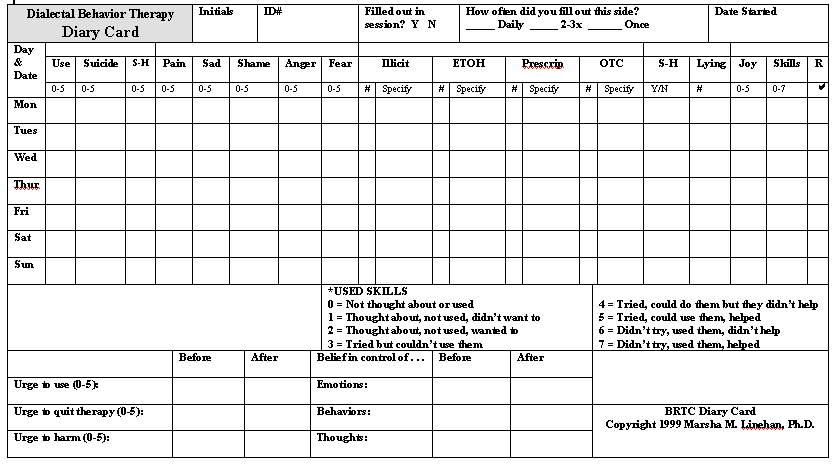
A DBT diary card is a structured record completed between therapy sessions. It helps a client and therapist review target behaviors, urges, emotions, and skills using information recorded across the week rather than relying only on a summary created in session.
Diary cards are one resource within comprehensive Dialectical Behavior Therapy (DBT), not a treatment by themselves. The VA describes full DBT as including individual psychotherapy, group skills training, in-the-moment phone coaching, and a therapist consultation team, and lists a standard diary card among the treatment’s manuals and resources. (VA MIRECC, n.d.)
For practical instructions on completing one, see how to fill out a DBT diary card with step-by-step examples.
What does a DBT diary card record?
The exact card varies by program and client. A card may include:
- Target behaviors: whether a selected behavior occurred, sometimes with a count.
- Urges: the intensity of a pull toward a target behavior, recorded separately from whether the action occurred.
- Emotions: names and intensity ratings using the scale printed on the card.
- DBT skills: which skills were attempted or practiced.
- Medication: whether prescribed medication was taken as directed, if the treating clinician includes that field.
No online example establishes a universal scale or field list. A client should follow the labels and review instructions provided by the treating clinician.
Why use a diary card?
A card creates a shared agenda for review. It can show that a strong urge did not become an action, distinguish a skill name from what the client actually tried, or identify a specific episode that needs closer assessment. The numbers organize observations; they do not diagnose a person, establish why a behavior occurred, or prove that a skill caused a change.
Recording closer to the relevant day can also reduce dependence on global retrospective summaries. Research on ecological momentary assessment notes that global retrospective self-report is vulnerable to recall bias and that real-time sampling is intended to minimize it. This measurement research did not test DBT diary cards. (Shiffman, Stone, & Hufford, 2008)
How therapists use the card
The therapist and client decide what belongs on the card and how to interpret its scales. During review, they can compare urges with actions, examine which skills were attempted, clarify missing or uncertain entries, and select episodes that warrant more detail.
When a target behavior occurred, the card identifies what happened but not necessarily how it developed. A behavior chain analysis can then reconstruct vulnerability factors, a prompting event, links, the selected target behavior, and consequences before mapping possible solutions.
Diary-card review remains part of a larger treatment process. The VA’s description of full DBT places the standard diary card alongside individual therapy, skills training, phone coaching, and the consultation team rather than presenting it as a standalone intervention. (VA MIRECC, n.d.)
Paper and digital diary cards
Paper and digital cards can represent the same clinical fields. Their workflow differs:
- A paper card stays with the client until it is brought or shared.
- A digital card can make an entry available through a clinician-facing system.
- Either format can contain incomplete, delayed, or uncertain information.
Dbrief’s therapist dashboard is designed for reviewing diary cards between sessions. This workflow description does not establish better completion, more accurate reporting, or improved clinical outcomes.
What a diary card cannot do
A diary card cannot replace clinical judgment, a treatment plan, or direct communication about urgent needs. An entry may not be reviewed immediately. If someone needs urgent help, they should use their established crisis plan, local emergency services, or crisis resources rather than relying on a paper or digital entry to alert a clinician.
The card’s role is narrower and useful: preserve structured observations so therapist and client can spend less time reconstructing the week and more time examining the treatment targets and skills they agreed to track.
Further reading:
- VA MIRECC. (n.d.). Dialectical Behavior Therapy recommendation resources. U.S. Department of Veterans Affairs.
- Shiffman, S., Stone, A. A., & Hufford, M. R. (2008). “Ecological Momentary Assessment.” Annual Review of Clinical Psychology, 4, 1–32. DOI 10.1146/annurev.clinpsy.3.022806.091415.
- Linehan, M. M. (2015). DBT Skills Training Handouts and Worksheets, Second Edition. Guilford Press.
- Linehan, M. M. (1991). “Cognitive-behavioral treatment of chronically parasuicidal borderline patients.” Archives of General Psychiatry, 48(12), 1060–1064.